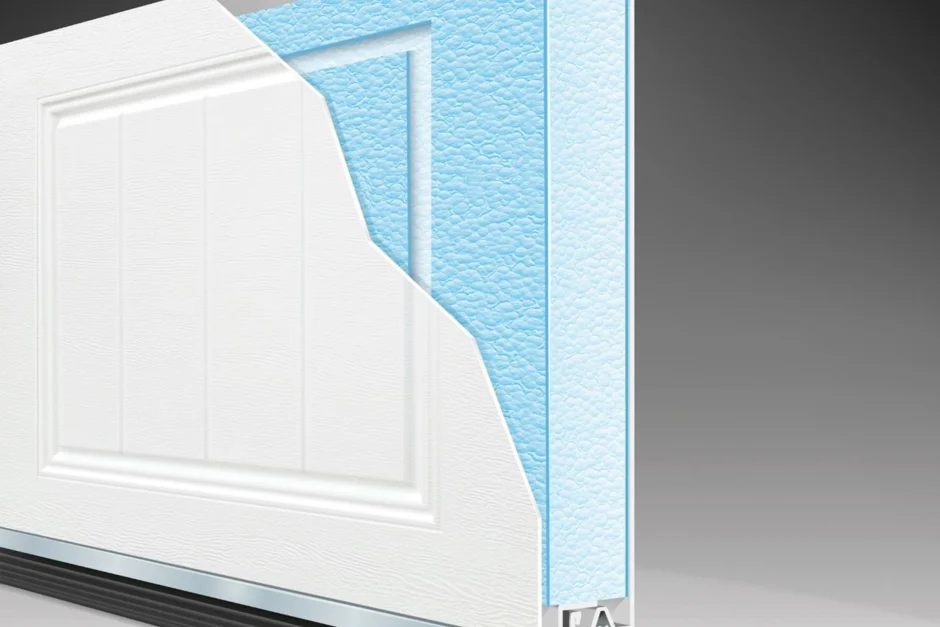
What does R-value actually mean on a garage door?
R-value measures how well a material slows heat moving through it. Higher is slower. On a garage door, the number describes the door's construction as a whole, and it is the easiest figure to compare between quotes, as long as you compare complete doors rather than the rating of a foam sample. The U.S. Department of Energy explains insulation ratings in plain language if you want the deeper version.
Two honest cautions belong beside every R-value claim. First, a garage is rarely heated or cooled like a living room, so a high R-value door does not make an unheated garage warm in January. It makes the space change temperature more slowly and stay closer to the house's temperature. Second, the panel is only part of the story. Gaps around the door leak more heat than the panel conducts, which is why seals get their own section below.
Polystyrene or polyurethane: what is the difference?
Most insulated steel doors use one of two fills. Polystyrene doors have rigid foam panels set into the back of each section, like a cooler built into the door. Polyurethane doors are filled by injecting foam that expands and bonds to both steel skins, so the section becomes one solid, stiff piece. Polyurethane typically delivers a higher R-value at the same thickness and makes a noticeably more rigid, quieter door.
That rigidity has a side benefit College Grove homeowners appreciate: a solid-core door rattles less, resists dents better, and feels substantial when it runs. The trade-off is price and weight. A polyurethane door is heavier, and the springs must be sized for that true weight. Manufacturers like Clopay publish construction details for both types if you want to compare before you call us.
When does insulation actually pay off in Middle Tennessee?
Insulation earns its money in three situations we see every week. The first is a room over the garage. Many homes in Falls Grove and across College Grove put a bedroom or bonus room on that floor, and its floor is the garage's ceiling. A door that slows summer heat and January cold makes that room noticeably easier to keep comfortable.
The second is a garage that works for a living: a workshop, a home gym, a place where someone is out there for hours in August humidity or on a cold morning. The third is a west-facing door baking in afternoon sun, which can turn an attached garage into a heat reservoir against the house wall. In all three cases the door is part of the home's comfort system, not just a lid on a parking space.
When is a single-layer door honestly fine?
Plenty of the time. A detached garage that stores cars, mowers, and holiday boxes does not need an insulated door, because nothing and nobody is being kept comfortable out there. The same goes for an unheated garage with no living space above it and mild use, or a door being replaced on a tight budget where the money serves the house better elsewhere.
We would rather tell you that than sell weight you do not need. A good single-layer steel door, correctly sprung and well sealed, will serve for years. Spend the difference on the seal package and on springs sized right, and you have a door that runs quietly and shuts tight, which matters more day to day than a rating on a brochure.
Why do the seals matter as much as the panel?
Heat and cold do not only move through the door. They move around it, through the gap at the floor and the daylight lines at the sides and top. A premium insulated door with a cracked bottom seal is a well-insulated wall with the window open. The seal package is part of the insulation decision, not an afterthought: bottom rubber that still flexes, a threshold where the slab needs one, and weatherstripping that actually touches the door frame all the way around.
If your current door is sound but the garage still bakes or freezes, look at the seals before you price a new door. Our weather seal replacement service exists for exactly that situation, and it is a fraction of the work of a door swap. Seals also keep out the wind-driven rain and the field mice that Tennessee garages attract.
What should you compare on a quote?
When you are ready to price a door, compare these items line by line rather than chasing a single R-value number.
- The whole-door R-value and the construction behind it: number of steel layers, insulation type, and whether the foam is bonded or loose-laid.
- The seal package included: bottom seal, threshold, and perimeter weatherstripping, stated in writing.
- Hardware rated for the door's true weight, with springs sized to the insulated door you are buying, not the lighter door coming off.
- Window options and their effect on insulation, since a row of windows is a row of lower R-value panels.
- What the installation includes: haul-away, track condition, and opener compatibility with the new door's weight.
Our garage door installation service quotes doors this way, and our installation cost guide for College Grove homeowners walks through the factors that move a quote before you ever call. On estate properties in The Grove, where doors are tall, wide, and often wood overlay, the insulation and weight conversation is also a spring and opener conversation, and it is worth having all of it at once.
Frequently Asked Questions
Are insulated garage doors worth it in Tennessee? They are worth it when the garage touches your comfort: a bedroom or bonus room above it, a workshop or gym inside it, or an attached wall shared with living space. Middle Tennessee summers and January cold snaps make those garages noticeably easier to live with. For a detached, unheated garage used for parking and storage, a basic door is usually fine.
What R-value should I look for in a garage door? There is no single magic number. Compare whole-door R-values between quotes, and weigh the rating against your situation: rooms above the garage benefit from the higher end of the residential range, while a detached garage gains little from any of it. Construction quality and seals matter alongside the number.
Does an insulated garage door make the garage quieter? Often, yes. A door with a bonded foam core is a solid, rigid panel, so it rattles and flexes less than a hollow single-layer door as it travels. Neighbors and bedrooms over the garage both notice. It will not silence a worn opener or dry rollers, which are separate noises with separate fixes.
Will a heavier insulated door work with my existing opener? Usually, provided the springs are sized for the new door's weight and the door balances correctly. The springs do the lifting; the opener guides the load. Whoever installs the door should fit matched springs and test the balance, and an older opener near the end of its life is worth an honest conversation at the same time.
How much does an insulated garage door cost in College Grove? Installation is quoted by door size, material, insulation type, and window choices, so a responsible number requires seeing the opening. We quote in writing before work starts. For context, repair work is separate: most repairs listed on this site run $129 to $399. Call (615) 314-2181 to start a quote.