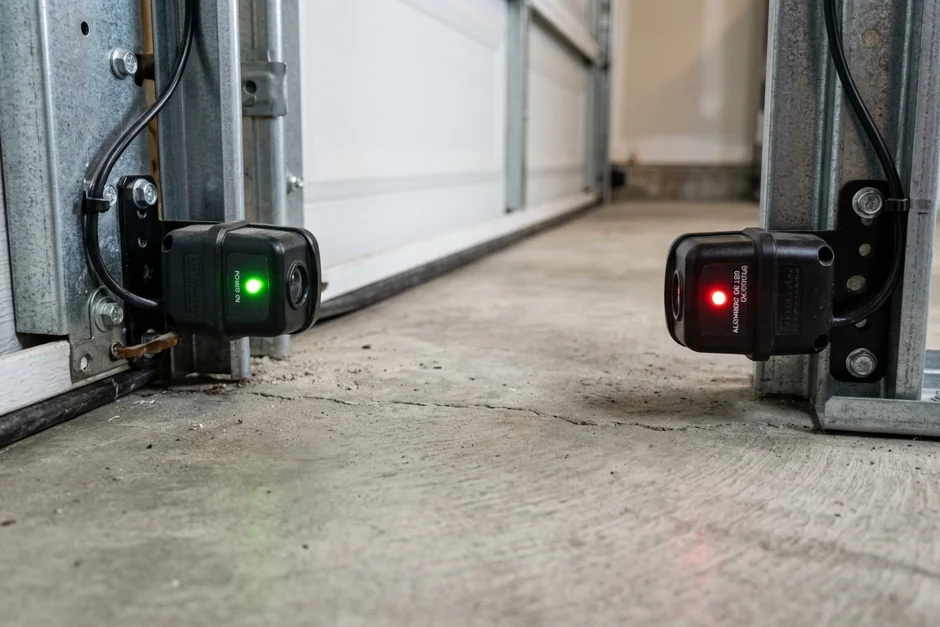
What is the most common reason a garage door will not close?
The photo-eye sensors are the most common reason, by a wide margin. These two small units sit near the floor on either side of the opening, a few inches up, and pass an invisible beam across it. If the beam is blocked, dirty, or knocked out of line, the opener reads the opening as obstructed and will not close the door, or starts down and reverses. It is doing exactly what it was built to do. The U.S. Consumer Product Safety Commission treats that beam as a core safety device, and entrapment protection like it has been required on residential openers for decades.
Check the little lights on the sensor bodies first. Typically one shows a steady light for power and the other confirms the beam is being received. A dark or blinking receiving light usually means the eyes are out of alignment, a lens is dirty, or something is in the way. Late afternoon sun can also blind the receiving eye on west-facing garages in College Grove, which is why some doors only refuse to close at one time of day. Our page on garage door sensor repair covers what a repair visit involves when the sensors themselves have failed. The LiftMaster site also explains what the sensor lights on their units mean if you want the manufacturer version.
Which checks can you safely do yourself?
Work through these in order. Every one of them is a look, a wipe, or a hand adjustment. None of them involves the springs, cables, or anything under tension.
- Clear the opening completely. Move boxes, bins, brooms, and bikes back from the doorway, and sweep the threshold. A small object in the beam path is the single most common fix.
- Wipe both sensor lenses with a soft, dry cloth. Dust, cobwebs, and pollen film build up fast in a Tennessee garage and scatter the beam.
- Look at the sensor lights. If the receiving light is blinking or off, gently move that sensor by hand until it points at its partner and the light goes steady. The brackets bend easily, which is both the problem and the fix.
- Check for a bent or blocked track. Follow each track with your eyes from floor to ceiling for a crushed section, a bolt backed out, or something leaning into the door's path.
- Try the wall button and a remote with fresh batteries. If the wall button closes the door but the remote does not, the door is fine and the problem is the remote.
- Watch where the door stops. A door that touches the floor and immediately reopens is often a close-limit setting telling it the floor is higher than it is. A door that stops at the same height every time is usually meeting the same obstruction.
If the door closes after the sensor nudge, test it twice more and check the auto-reverse by waving a box through the beam as it closes. It should reverse promptly. That test is not optional; the reverse system is a required safety feature, not a suggestion.
What if the door starts down, then reverses for no clear reason?
A door that travels partway and reverses is reading resistance somewhere and treating it like an obstruction. Worn rollers are a frequent cause: a roller with a cracked wheel or a seized bearing binds in the track, the opener senses the extra force, and it backs the door up. A slightly bent track does the same thing at the same spot every cycle, which is the clue to look for.
Opener force settings can also drift or be set too low for a door that has grown heavier with age, moisture in a wood door, or a weakening spring. This is where we ask homeowners to resist the obvious temptation. Never tape over the sensors, never hold the wall button down to force a close, and never turn the force setting up to overpower a binding door. You would be defeating the system that keeps a closing door from injuring a child or a pet. Resistance has a cause, and the cause is the repair. If the binding is in the track or rollers, track repair is usually the right visit, not a new opener.
Can the floor or the weather seal stop a door from closing?
Yes, and this one surprises people. If the concrete slab or the driveway apron heaves slightly, or a new, thicker bottom seal is fitted, the door meets the floor sooner than the opener expects. It reads that early contact as an obstruction and reverses, or it stops with a small gap and a flashing light telling you the close limit needs attention. Newer College Grove subdivisions see slab movement as the ground settles, and we get this call fairly often from Reeds Vale, where most homes are still in their first decade.
Look at the gap with the door closed as far as it will go. A gap that is even across the width points at the limit setting or the seal. A gap that is open on one side and shut on the other points at something structural: a shifted track, a bent section, or a door that has come partly off level. The even gap is a small adjustment. The lopsided gap is a call.
When is it time to stop checking and call?
Stop and call when you see any of the following, because each one sits next to parts under spring tension or affects whether the door can fall.
- The door sits crooked in the opening, or one side closes lower than the other.
- A lifting cable looks frayed, slack, or has jumped off its drum.
- A track is visibly bent, torn from its brackets, or the door has come out of the track at any point. That is an off-track repair, and the door should not be run at all.
- The sensor wires are cut, chewed, or hanging loose, or a sensor body is cracked.
- The opener grinds, hums without moving the door, or the door will not stay up when disconnected. Those symptoms overlap with the ones in our guide to signs an opener needs repair.
Homes across McDaniel Estates and the rest of 37046 can reach us during regular hours, Monday to Friday 7AM to 7PM and Saturday 8AM to 4PM, with emergency help after hours for a door stuck open. A door that will not close is a security problem, not a cosmetic one, and it is worth treating the same day.
Frequently Asked Questions
Why won't my garage door close all the way? The photo-eye sensors are the most common cause. If the beam between them is blocked, the lenses are dirty, or one sensor has been knocked out of line, the opener treats the opening as obstructed and refuses to close or reverses. Clean the lenses, clear the opening, and nudge the sensor until its light is steady.
Why does my garage door go down and then back up? The opener is sensing resistance and reversing as a safety response. Worn rollers, a binding or bent track, a drifting force setting, or the door meeting a heaved section of floor can all trigger it. The reverse is a required safety feature. The fix is finding what the door is pushing against, not raising the force.
How do I align my garage door sensors? Most sensors sit in brackets that move with firm hand pressure. Loosen nothing unless there is a wing nut meant for adjustment. Point the sending eye at the receiving eye until the receiving light changes from blinking to steady, then test the door twice and confirm it reverses when the beam is broken.
Can sunlight stop a garage door from closing? Yes. Strong low sun shining straight into the receiving sensor can overwhelm the beam, so the door refuses to close late in the day and works fine in the morning. Shade the receiving eye with your hand and try again. If it closes, the sensors are healthy and the angle of the sun is the problem.
How much does it cost to fix a garage door that will not close in College Grove? Most repairs listed on this site run $129 to $399. A sensor alignment or replacement sits toward the lower part of typical repair work, while track or roller damage costs more. You get the exact price before any work starts. Call (615) 314-2181 and tell us where the door stops.